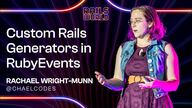
 Rails World 2026: Custom Rails Generators in RubyEvents (Rachael Wright-Munn)
Rachael Wright-Munn is one of the maintainers of RubyEvents.org, the open source index of Ruby conferences and talks. The talk is a hands-on guide to writing custom Rails generators, plus a small experiment comparing how agents perform with and without them.
Key ideas #
The problem: YAML and strangers #
RubyEvents stores all event data as YAML in the repo: reviewable for spam, editable by anyone, and safe if the app ever disappears. The downside is that every data change is a commit.
Both agents and the 180+ human contributors struggled the same way. They invented keys, used deprecated formats, missed TODO comments, and burned time (or tokens) reverse-engineering examples. Event files also go through phases (speakers announced, schedule released, videos published), and agents mostly see finished files.
Rachael picked skill + CLI over an MCP server, so contributors without AI tokens could use the same tool. For the CLI, Rails generators were the obvious fit: arguments, options, ERB templates, help text, tests and file-conflict handling come for free. They are built on Thor.
Building a generator #
Start with the generator generator:
bin/rails generate generator cfp
The default class inherits from Rails::Generators::NamedBase, which takes a name argument and gives you lots of naming helpers. RubyEvents doesn’t need a name, so its generators inherit from Rails::Generators::Base.
Inputs come in two flavours. Arguments are positional, like method arguments. Class options are flags in any order, like keyword arguments. Rachael prefers options, because order mistakes disappear. Here is the real CFP generator, trimmed:
class CfpGenerator < Generators::EventBase
  source_root File.expand_path("templates", __dir__)

  class_option :name, type: :string, desc: "CFP name", group: "Fields"
  class_option :link, type: :string, desc: "CFP link", group: "Fields"
  class_option :open_date, type: :string, desc: "CFP open date (YYYY-MM-DD)", group: "Fields"
  class_option :close_date, type: :string, desc: "CFP close date (YYYY-MM-DD)", group: "Fields"
end
Every class_option shows up in bin/rails generate cfp --help automatically. The USAGE file is appended to that help, and that is where Rachael put examples for each state: a minimal CFP, an ongoing meetup CFP with no end date, a lightning-talk CFP, and how to extend a deadline. When an agent calls --help, it gets all that context for free.
Templates are .tt files (Thor templates) written in plain ERB. Use <%- and -%> to trim whitespace in conditional lines, since nothing cleans up YAML the way a browser cleans up HTML. You can also override the templates of Rails’ built-in generators by placing your own in lib/templates.
Testing generators #
Rails::Generators::TestCase gives you run_generator (pass the same flags you’d type on the CLI) and assert_file. Two gotchas:
- The default setup calls
prepare_destination, which wipes and recreates one sharedtmpfolder. That gets flaky with parallel tests. RubyEvents uses a unique temp directory per test instead:
setup do
  self.class.destination Dir.mktmpdir("cfp_generator", Rails.root.join("tmp").to_s)
end
teardown { FileUtils.remove_entry(destination_root) }
-
run_generatorcaptures stdout, sobinding.irbappears to hang. Run the test withRAILS_LOG_TO_STDOUT=trueto see output while debugging. It is documented near the end of the Rails generators guide.
Generators as MCP tools #
The class options already describe everything an MCP tool needs. RubyEvents now has a script that turns each generator into an MCP tool for its server, so a merged generator change shows up as an updated tool after a restart.
The experiment #
Rachael asked GPT 5.4 to add Rails World 2026 from a markdown file, rolling the improvements back in one at a time:
- No tooling: four errors, including pulling in 2023 sponsor logos. $1.83 and 136,000 tokens.
- Generators only: two errors.
- Generators + skill: one error, swapping em dashes for hyphens.
- MCP: cheapest, but it quit halfway with no videos, schedule or sponsors.
The surprise came from smaller models. With good tools, a small model finished one run for 39 cents with zero mistakes, because it didn’t go off script or rewrite descriptions. Rachael’s conclusions: skills made fewer mistakes but cost more, and the token cost of MCP may be overblown.
My takeaways #
- Tell your agent to use Rails generators (including
rails g migration) instead of writing files by hand. - Write a custom generator for the thing your team creates most often, and put real examples in its USAGE file.
- Customize the default scaffold templates in
lib/templatesto match your conventions. - For narrow, repeatable tasks, try a smaller model with a good CLI before reaching for the biggest one.
Watch the full talk: Custom Rails Generators in RubyEvents
Did you like this article? Did it save you some time?