---
title: "Gem Meta Tags for better SEO"
author: "Yaroslav Shmarov"
date: "2021-10-28"
canonical_url: "https://blog.superails.com/meta-tags-without-a-gem"
markdown_url: "https://blog.superails.com/meta-tags-without-a-gem.md"
description: "Meta tags are important for your website/webapp. For example title, description, favicon help with for SEO and visibility: og:image, og:title, og:description…"
tags: ["ruby","rails","ruby-on-rails","SEO","meta-tags"]
license: "GNU AGPL v3. Credit Yaroslav Shmarov and link the canonical URL."
---
# Gem Meta Tags for better SEO
Meta tags are important for your website/webapp.
For example `title`, `description`, `favicon` help with for SEO and visibility:

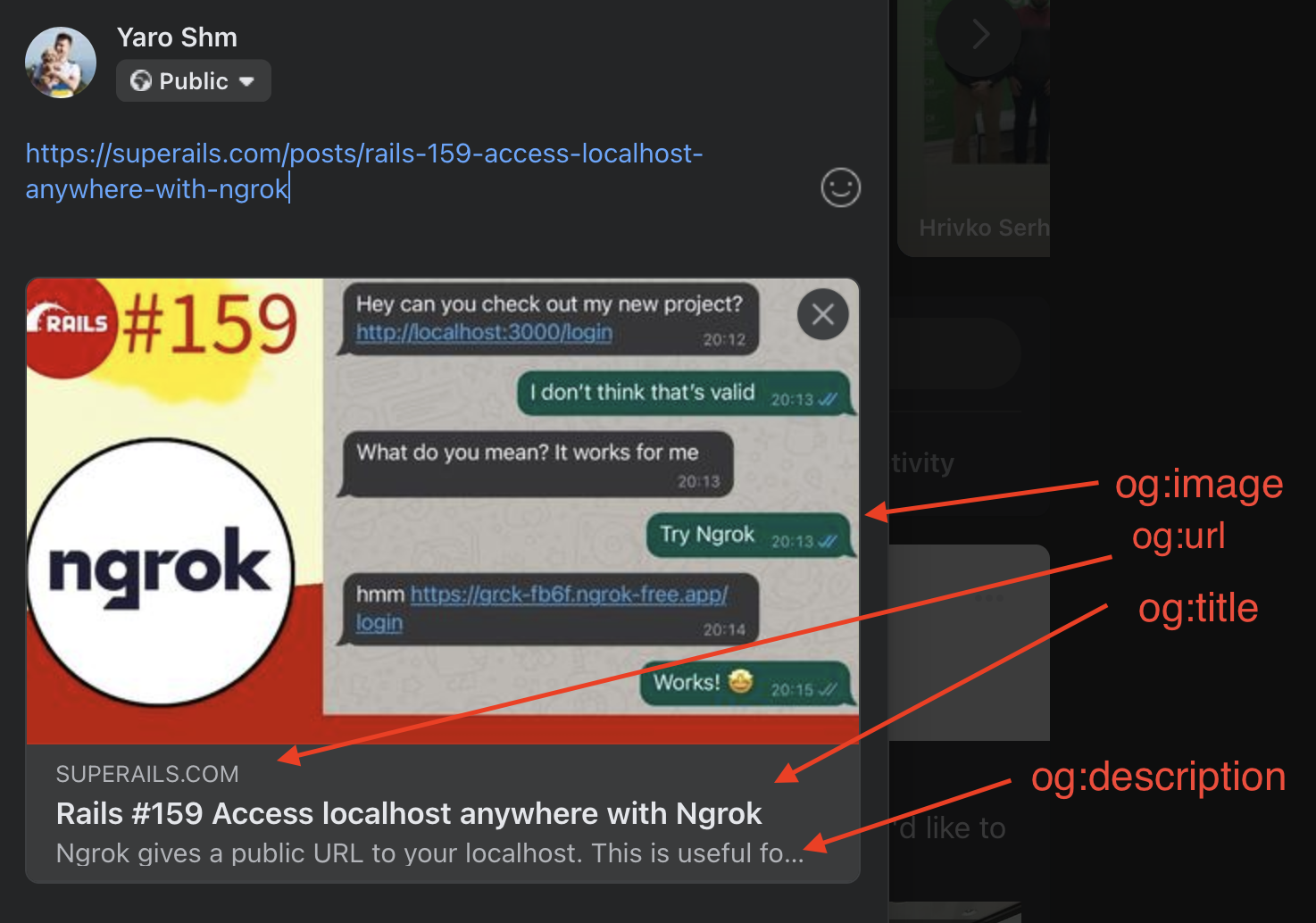
`og:image`, `og:title`, `og:description`, `og:url`, make link previews look nice when sharing on social:
`title` tag makes browser tab readable:

Here's how basic meta tags can look in the `` of an HMTL document:
```html
Playlists | SupeRails
```
ℹ️ the `keywords` meta tags is [no longer relevant](https://ahrefs.com/blog/meta-keywords/#:~:text=Meta%20keywords%20are%20meta%20tags,are%20not%20visible%20to%20visitors.&text=It%27s%20easy%20to%20add%20meta,%27%2C%20but%20should%20you%20bother%3F) ☠️
```diff
-
```
### Add a favicon in a Rails app
First, add the favicon image into the `app/assets/images/thumbnail.png` folder.
```ruby
# app/views/layouts/application.html.erb
<%= favicon_link_tag 'thumbnail.png' %>
# produces
```
Great in-depth article: [How to Favicon in 2024: Six files that fit most needs](https://evilmartians.com/chronicles/how-to-favicon-in-2021-six-files-that-fit-most-needs)
### Dynamic `` and other meta tags
If a page has a custom title, display it. Otherwise display just _"SupeRails"_:
```ruby
# app/views/layouts/application.html.erb
<title><%= content_for?(:title) ? yield(:title) : "SupeRails" %>
<%= yield :meta_tags %>
```
Now you can add a title tag to any page:
```ruby
# app/views/posts/index.html.erb
<% content_for :title do %>
<%= pluralize Post.count, 'post' %>
|
<%#= Rails.application.class.parent_name %>
<% end %>
```
The above generates a title `5 posts | SupeRails`.
Set other meta tags; assuming you stored an image in `app/assets/images/banner.png`:
```ruby
# app/views/posts/index.html.erb
<% content_for :meta_tags do %>
<% end %>
```
```ruby
# app/views/posts/show.html.erb
<% content_for :title do %>
<%= @post.title %>
|
<%= Rails.application.class.module_parent_name %>
<% end %>
# => "How to create meta tags | SupeRails"
```
### Image meta tag
Assuming you have a `Post` model that `has_one_attached :cover_image`, you can use it OR fallback to a default image if nothing is attached:
```ruby
def og_image(post)
post.cover_image.attached? ? url_for(post.cover_image) : asset_url('banner.png')
end
```
```ruby
```
### Use [gem meta-tags](https://github.com/kpumuk/meta-tags)
For more complex behaviour and more meta_tag types (like `description`, `tags/keywords`, `image`, [OpenGraph](https://ogp.me/)), better use [gem meta-tags](https://github.com/kpumuk/meta-tags).
```sh
# console
bundle add meta-tags
rails generate meta_tags:install
```
Add `display_meta_tags` to the layout, where you can set the default meta tags for all pages:
```ruby
# app/views/layouts/application.html.erb
<%= display_meta_tags site: Rails.application.class.module_parent.name,
description: 'Modern Ruby on Rails screencasts',
keywords: 'ruby, rails, ruby-on-rails',
reverse: true, # app name at the end like `5 posts | SupeRails`
image: asset_url("logo.png"),
og: {
image: asset_url("logolong.png"),
}
icon: "/favicon.png", type: "image/png"
%>
```
Override the default meta tags from a controller action with `set_meta_tags`:
```ruby
# app/controllers/posts_controller.rb
def index
set_meta_tags title: "#{Post.size} posts"
end
def show
set_meta_tags title: @post.name,
description: @post.description,
keywords: @post.tags.pluck(:name).split(', ')
end
def new
set_meta_tags title: "#{action_name.capitalize} #{controller_name.singularize}" # New post
end
```
You can also customize the settings in a config file:
```ruby
# config/initializers/meta_tags.rb
MetaTags.configure do |config|
config.title_limit = 200
config.truncate_site_title_first = true
end
```
Example implementations:
- [insta2blog.com](https://github.com/yshmarov/insta2blog.com/commit/64d690a0e967027c87de13de8cb39113d28cf538){:target="blank"}
- [old SupeRails](https://github.com/yshmarov/superails-rails6/commit/d489756cc1f1b181e90f86c909d5ba9ce113ff1b){:target="blank"}
### Testing OpenGraph
ℹ️ [OpenGraph API](https://ogp.me) meta tags are used to improve the appearance and functionality of shared links on social media platforms
Use [Ngrok](https://blog.superails.com/ngrok) to get a public URL to your localhost, and use a meta tag previe tool to test how your website renders.
Preview tools:
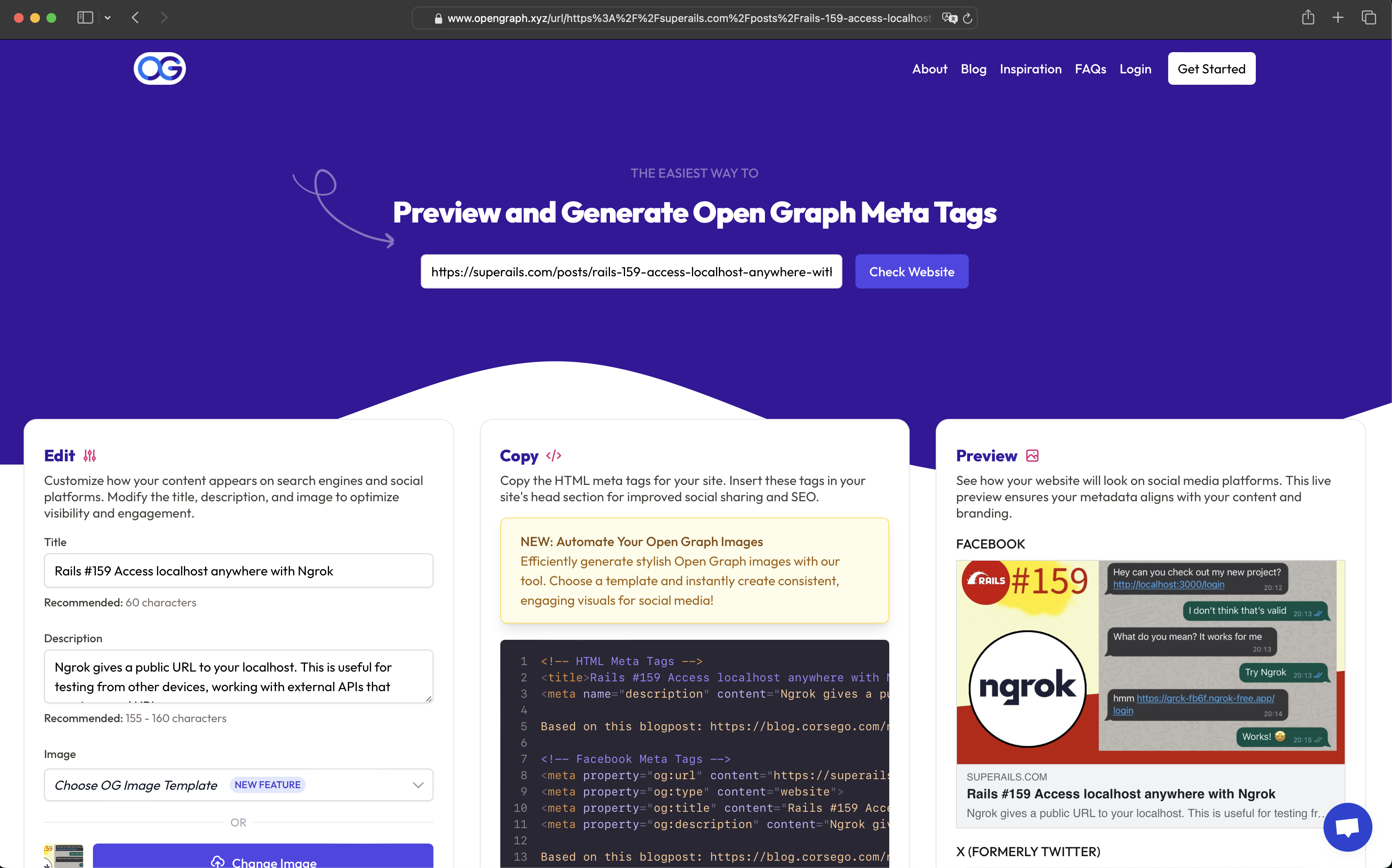
[opengraph.xyz](https://www.opengraph.xyz/url/https%3A%2F%2Fsuperails.com%2Fposts%2Frails-158-build-a-calendar-from-zero-no-external-dependencies) - VERY GOOD PREVIEW TOOL ✅
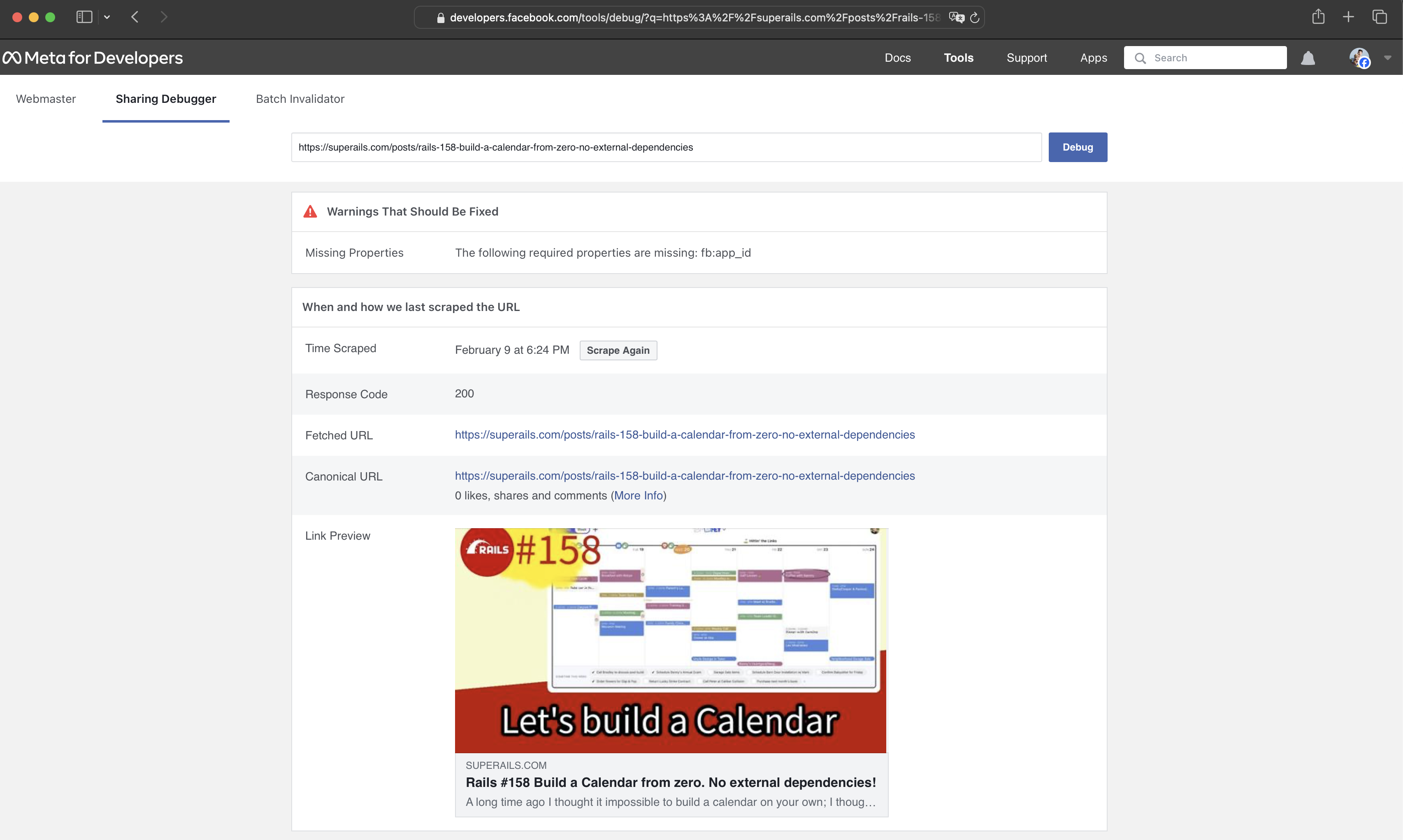
[Facebook OG](https://developers.facebook.com/tools/debug/)
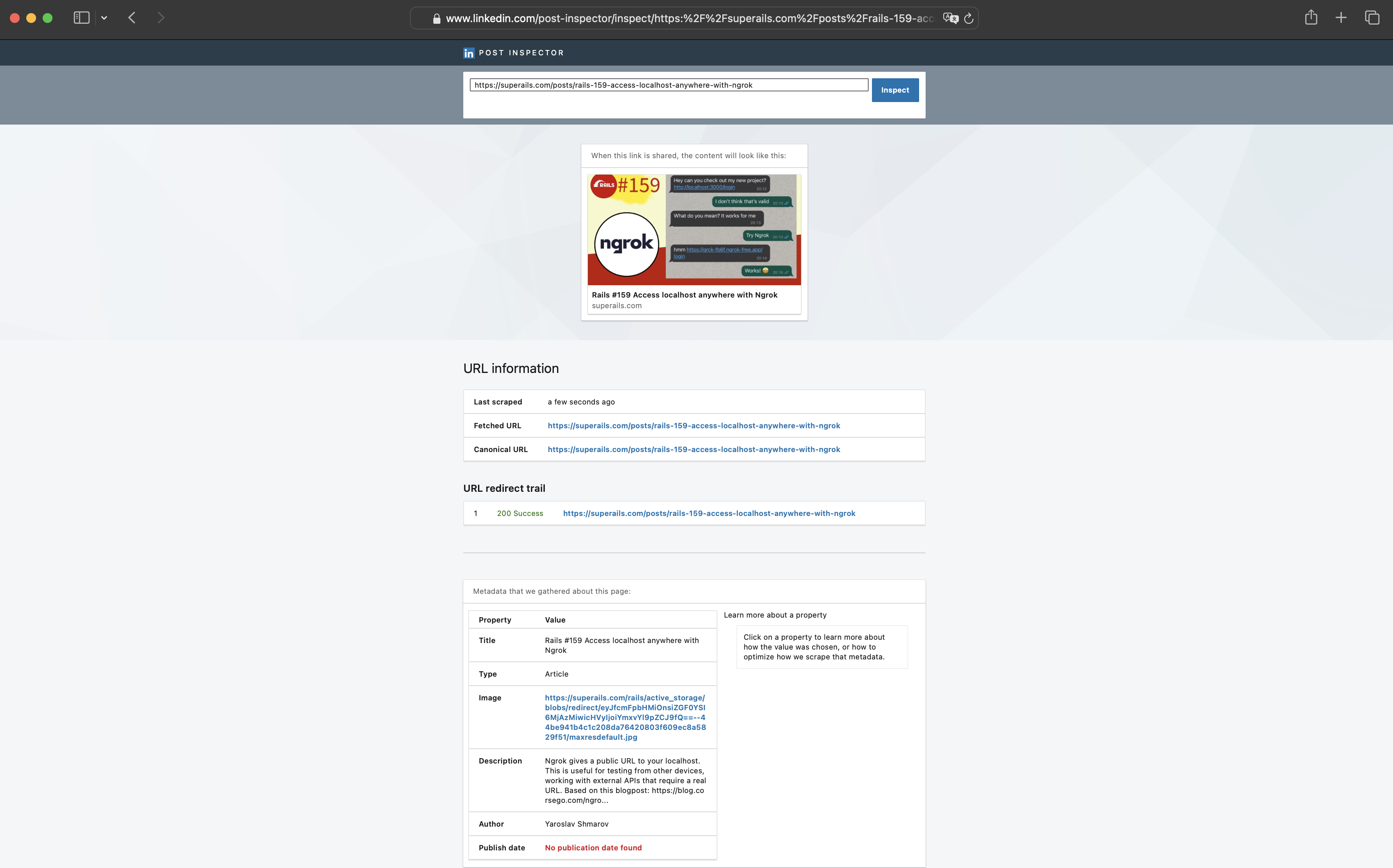
[Linkedin OG](https://www.linkedin.com/post-inspector/inspect/https:%2F%2Fsuperails.com%2Fposts%2Frails-159-access-localhost-anywhere-with-ngrok)
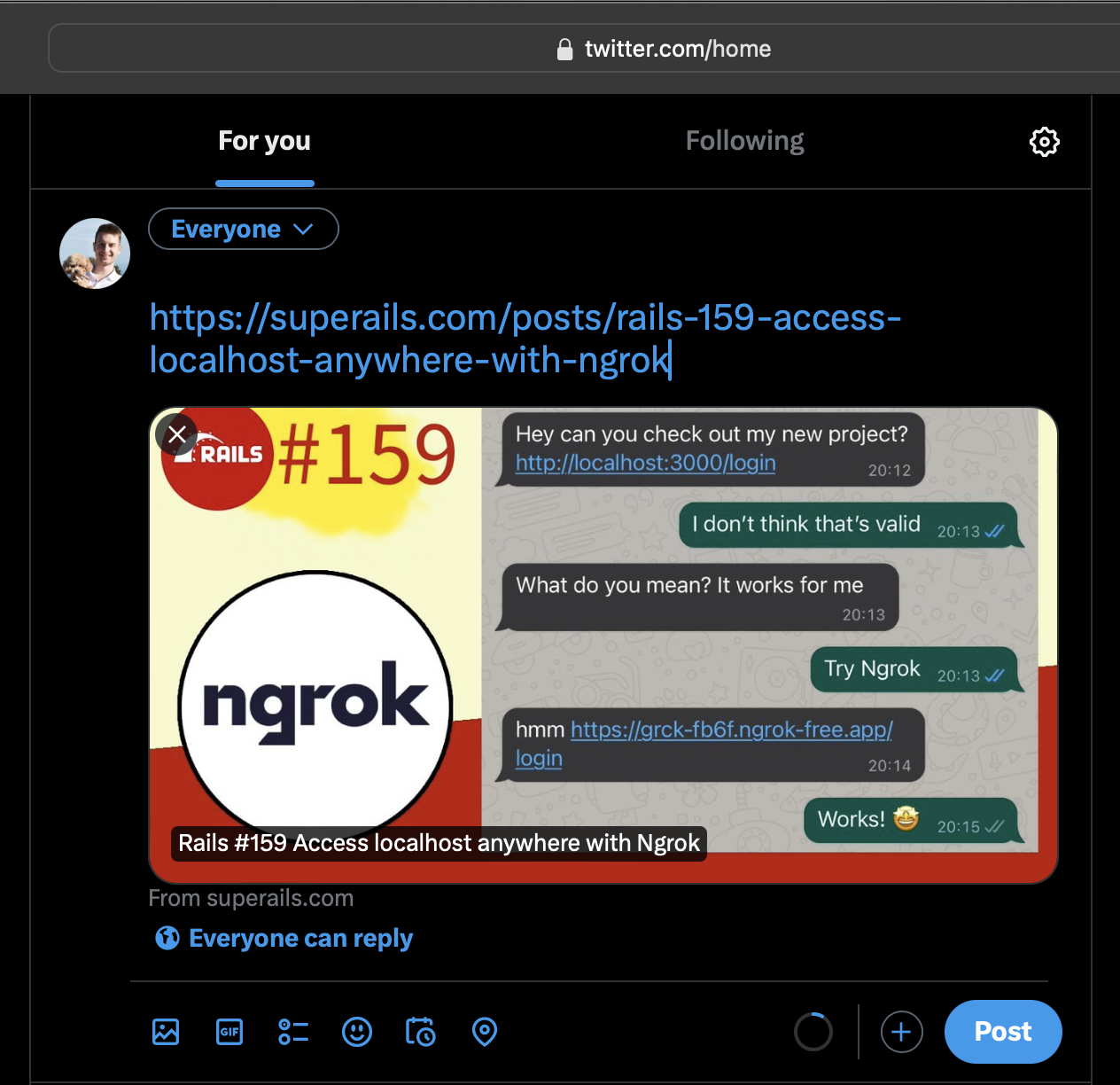
[Twitter OG cards docs](https://developer.twitter.com/en/docs/twitter-for-websites/cards/overview/abouts-cards). They have discontinued their preview tool. Log in, click on "create post", paste a link, and wait for it to render.
### Final thoughts
💡 There are many tags and it can seem a bit overwhelming to set them all. First focus on the more important meta tags, than do the other ones.
💡 Open Graph image generator sounds like a good SaaS idea: